
Mining companies possess abundant copper sulfide ore resources. Therefore, understanding the technological process and related equipment for extracting copper from copper sulfide ore is crucial. This not only improves extraction efficiency but also increases economic benefits.
Sandreck, as a manufacturer of mining equipment, not only provides high-quality ore processing equipment but also possesses extensive experience in ore extraction. Below, we will detail the technological process for extracting copper from copper sulfide ore.
1. Ore Pretreatment Stage
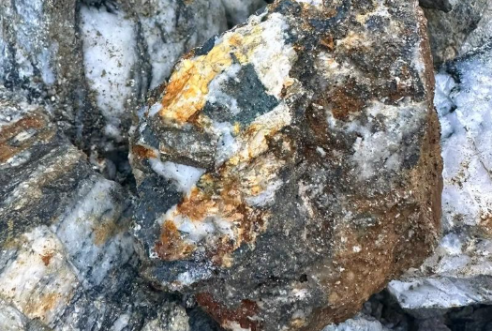
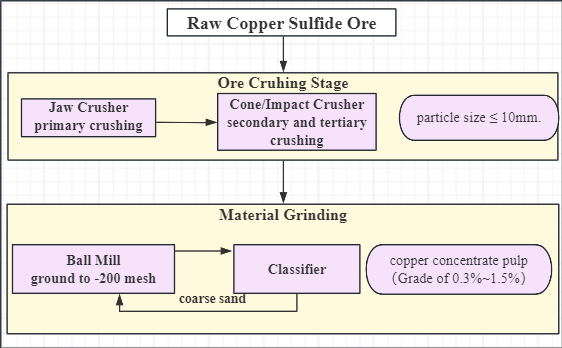
Copper sulfide ore typically has a low grade (generally 0.5%-3%), making direct smelting very costly. The first step in extracting copper from copper sulfide ore is crushing and grinding the ore to separate copper mineral particles from the gangue.
1) Ore Crushing
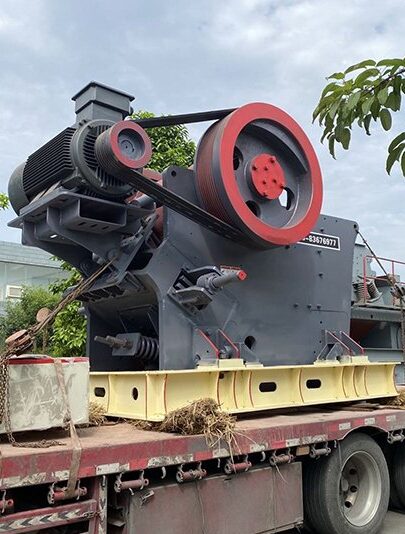
First, large pieces of copper sulfide ore are primary crushed using a jaw crusher. Then, secondary and tertiary crushing is performed using an impact crusher or cone crusher to further reduce the particle size. This process yields copper sulfide ore with a final particle size of less than 10 mm.
2) Material Grinding
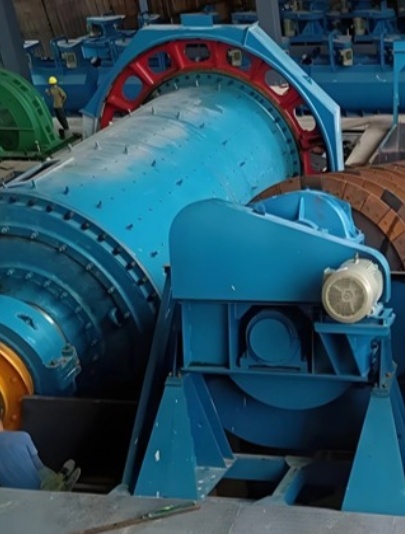
Fine sand with a particle size ≤10 mm is ground to -200 mesh using a ball mill. This step effectively separates the copper minerals from the gangue, thereby maximizing the project’s metal recovery rate.
3) Coarse Sand Screening
If there is too much coarse sand, a classifier can be used for secondary screening. The coarse sand portion is returned to the grinding mill, minimizing the generation of defective products.
2. Copper Ore Flotation and Separation
Finely ground sulfide copper ore has a low grade (0.3%–1.5%), limiting its profit potential. Enriching the copper ore through chemical and physical methods can improve its grade, thereby creating greater economic value.
1) Pulp Conditioning and Reagent Addition
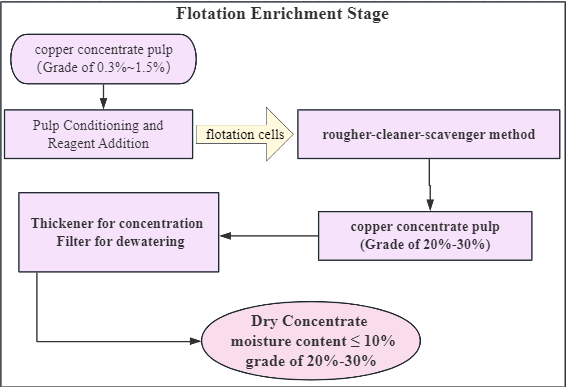
Flotation reagents (including frothers, collectors, and modifiers) are precisely formulated according to the ore characteristics. Optimizing the reagent formulation can stably increase the copper concentrate grade to over 20%, thereby enhancing product value and market competitiveness.
2) Aeration and Flotation
After adding reagents, the slurry enters the flotation cell. A roughing-cleaning-scavenging method is used to separate copper minerals from gangue. Through flotation enrichment, a copper concentrate slurry with a grade of 20%–30% can be obtained.
3) Separation of Dry Concentrate
The copper concentrate slurry is processed. A thickener is used for concentration, and a filter is used for dewatering. This yields dry concentrate with a moisture content of less than 10%, suitable for transportation or further smelting and refining.
3. Pyrometallurgy
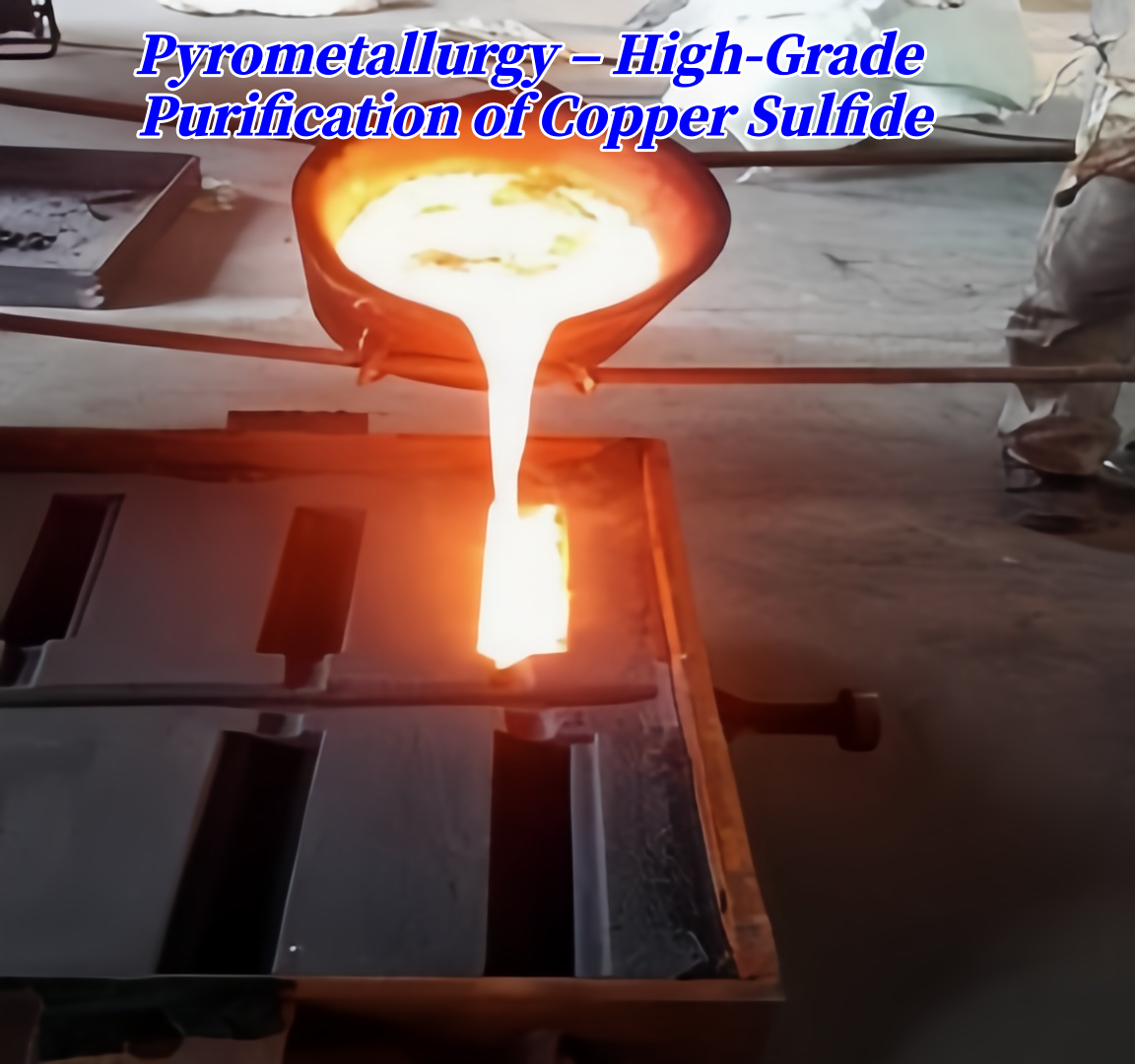
The higher the grade and purity of copper ore, the higher its value. Pyrometallurgy is currently the most mature industrial method for processing copper sulfide ores and the preferred process for extracting copper from 80% of copper sulfide ores globally. It can increase the grade of dry concentrate to over 90%.
If your copper sulfide ore grade is ≥20% and you need to extract high-grade copper on a large scale, choose pyrometallurgy.
Pyrometallurgy mainly includes four steps: roasting/drying, smelting, conversion, and refining.
Step 1: Roasting/Drying
Dry the copper concentrate to a moisture content ≤0.5%. For high-sulfur copper concentrates, roasting is necessary to remove some sulfur and harmful impurities such as arsenic and antimony, preparing it for subsequent smelting.
Step 2: Smelting
Mix the copper concentrate, flux, and coke in a specific ratio and feed them into a high-temperature furnace (flash furnace or blast furnace) at 1200-1300°C. This step yields matte with a purity of 40%–50%.
Step 3: Converter Copper Refining
The matte undergoes deep oxidation in a high-temperature converter at 1150–1250°C to remove impurities such as iron and sulfur. This step yields blister copper with a purity of 98.5%–99.5%.
Step 4: Refining
The blister copper can be further refined using pyrometallurgical and electrolytic methods. This step is crucial not only for increasing purity but also for obtaining substantial additional profits.
- Pyrometallurgical Refining: The blister copper is heated in a reverberatory furnace for further oxidation and impurity removal, then cast into anode copper with a purity of 99.5%–99.7%. The anode copper can be sold directly or further refined to achieve even higher purity.
- Electrolytic refining: Electrolytic refining of anode copper can produce high-quality cathode copper with a purity of 99.95%~99.99%, enabling your products to enter the high-end market and obtain a premium. Furthermore, the anode sludge produced in this process is rich in precious metals such as gold and silver, which can bring considerable additional revenue.
4. Hydrometallurgy
While pyrometallurgy is currently the mainstream technology for processing copper sulfide, hydrometallurgy is more suitable for some low-grade (0.2%-1%) or difficult-to-process ores. The principle of this process is to dissolve copper using chemical reagents, followed by extraction and electrolysis.
Process 1: Sulfate Leaching Electrolysis
This method involves three steps: roasting conversion, acid leaching purification, and electrolysis. It can stably convert medium- and low-grade copper sulfide ore into high-purity cathode copper, with a recovery rate of 85%-90%.
Process 2: Bioleaching
This is currently the most environmentally friendly and economical option. Utilizing microorganisms for natural leaching, copper resources can be recovered from ultra-low-grade ores or tailings. Energy consumption is only one-tenth that of traditional pyrometallurgy, and investment is only one-fifth. Furthermore, the entire process produces zero sulfur dioxide emissions.
Process 3: Pressure Oxidative Leaching
If your ore has a high sulfur content and is difficult to process, please choose pressure oxidative leaching. This process can effectively solve the problem of extracting finely dispersed sulfide ores that are difficult to float, with a recovery rate of over 90%.
For mining companies, optimizing every step of the copper extraction process from copper sulfide ore can bring tangible benefits. This optimization means you can utilize mineral resources more fully while reducing energy consumption and environmental pollution during production.
Therefore, choosing the right extraction process and equipment directly impacts your economic benefits. Sandreck provides professional mining machinery and equipment. Our chief engineer can provide customized process selection and equipment configuration solutions based on your specific needs. Please feel free to contact us with any related questions!