
Selecting the best jaw crusher is not so much about buying the largest, or most expensive, machine available. It is about matching powerful technology with your exact needs. Choosing incorrectly can be a recipe for costly inefficiencies and reduced production. Sandreck Mining Machinery is a professional jaw crusher supplier in China. This article will introduce the key factors in choosing a jaw crusher, helping you make an informed choice and get the most from your investment.
Step 1: Know Your Crushing Material
The type of rocks or minerals you want to crush will dictate the fundamental requirements of the jaw stone crusher. The quickest way to ruin something is to overlook this point.
Hardness and Abrasiveness:
Are you working with hard granite, basalt, softer types of limestone, or recycled concrete? Hard and, especially, abrasive materials require a better Crusher with the type of wear-resistant parts (for example, high-manganese steel jaw plates) that will give you some wear-resistance and the right type of design (for instance, a double-shoulder Jaw Crusher is typically designed for this type of use, and is also known for handling rough circumstances). (Answer to “Which Jaw Crusher for hard rock?”)
1) Input Size:
What is the maximum size of the rocks or particle size you can put through (process) the Crusher? This will determine the feed opening width of the Crusher directly.
2) Output Size:
What is the minimum particle size required in the final product? This will determine both the adjustment range required of the discharge opening (CSS), and if you require a secondary crushing stage to obtain your final product size.
3) Water and Clay Content:
Moist, sticky materials can cause blockages. Anti-blockage Crusher designs (i.e., a steeper crushing chamber, larger discharge openings) are key in this consideration.
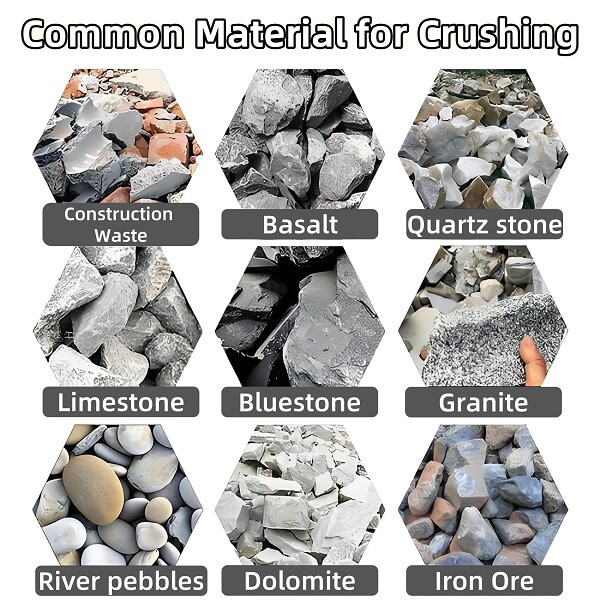
Figure 1 Common Material for Crushing
Step 2: Clarify Your Production Needs
The hardness and density of the material are crucial to the crushing operation. Hardness affects the crushing energy consumption and component wear, while density is related to the fluidity of the material in and out.
The uniformity of the feed particle size distribution is critical. When it is uniform, the Crusher load is stable and conducive to operation; when it is uneven, the equipment may be overloaded when processing large particles, affecting its life and efficiency.
In terms of the desired discharge particle size, a smaller CSS (discharge port setting value under closed-loop circulation) usually corresponds to a lower production capacity. Because finer discharge particle sizes require more time and energy to crush, resulting in a decrease in output per unit time.
The selection of jaw crusher models and specifications requires comprehensive factors such as material characteristics, feed particle size distribution and desired discharge particle size.
The location and frequency of crushing will dictate the type of mobility. It is also an important cost and operational consideration.
Step 3: Site and Mobility
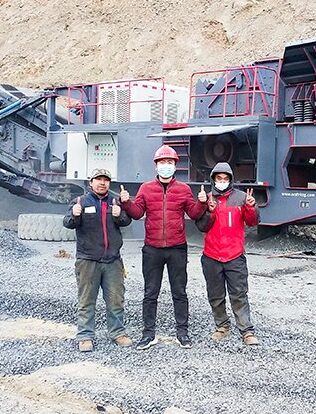
1. Mobile Jaw Crusher (Tire/Crawel):
- Set-up: Requires minimal preparation and can be driven directly to the job site without a permanent foundation.
- Mobility: Highly flexible and often chosen by contractors handling multiple projects. Used where site constraints exist and crushing at the source helps reduce transportation costs.
- Capacity: Very good throughput for its class. However, the maximum throughput will typically be less than that of a large fixed piece of equipment.
- Cost advantage: Saving on transportation costs for materials can be significant, especially when fast setup and flexible movement are required. It can be more cost-competitive for projects that require relocation or where crushing is done in its entirety at the source.
- Situations: Short-term contracts, multi-site projects, urban demolition – recycled materials crushing, remote sites, and sites where material can be crushed in situ at the extraction point.
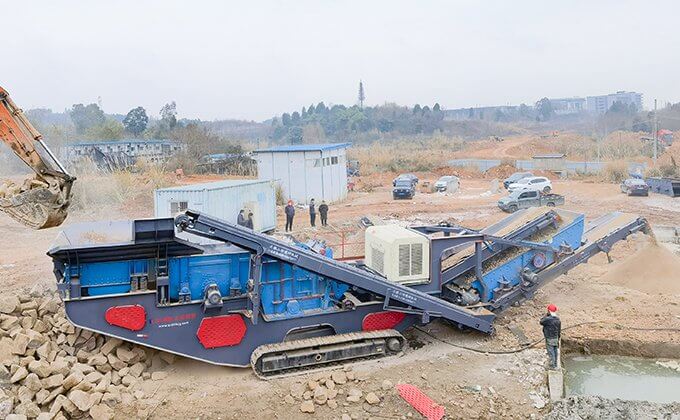
Figure 2 Crawl Jaw Crusher
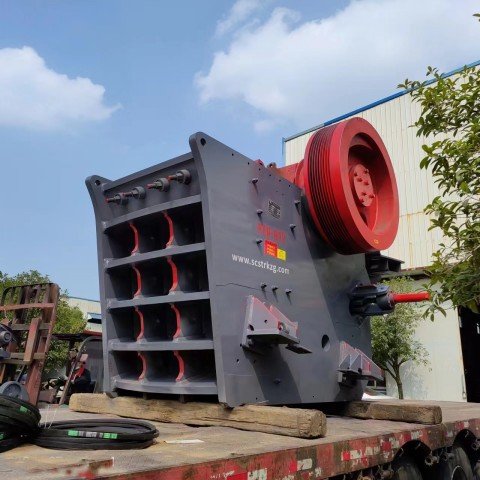
2. Fixed Jaw Crusher:
- Installation and set-up: high initial cost, concrete pad, needs to be tied in to feeding and conveying.
- Mobility: fixed in place, disassembly for moving is considerable and costly.
- Productivity: designed to run at maximum throughput and efficiency; it is the heart of any production line of large stone and very large-scale 24-hour mining operation.
- Cost advantage: when production is performed at high volume, co-existing long term, on one site, the ton cost can be the lowest, and the high initial investment will be compensated for by long-term, high efficiency.
- Applicable scenarios: large quarry operations, mines, permanent aggregate production sites, and sites with many years of experience and a goal to maximize production.
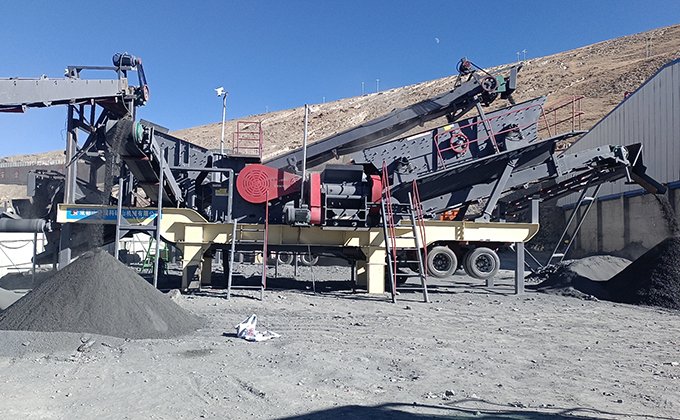
Figure 3 Fixed Jaw Crusher
Step 4: Consider Total Cost and Long-Term Value
Purchase price may just be the beginning, but total cost of ownership is where it counts.
1. Consumption of Wear Parts:
2. Energy Efficiency:
Stone crusher machines have different drive types (electric/diesel). Different designs with different energy consumption rates; efficient operation is an important consideration in reducing costs.
3. Maintenance Requirements:
You need to ensure your components, such as jaws and toggle plates, are checked and replaced. A hydraulic adjustment setup would likely present complications, and downtime would be required to adjust the CSS (closed side setting). Durability in designs can allow for intervals in between overhauls.
Step 5: Compare Key Specifications and Features of the Jaw Stone Crusher
- Feed opening: has to allow the maximum feed size.
- Motor power: must provide crushing force sufficient to crush the material to the required hardness and achieve the required TPH.
- CSS range: specifies maximum particle size adjustment, and broader ranges give greater product flexibility.
- Crushing chamber design: affects efficiency, product shape (cubic is more ideal), and uniformity of jaw wear. Tt can maximize production and minimize cycle loads with the optimal design.
- Adjustment method: Hydraulic adjustment is a key factor in many modern operations. It funds the operator to quickly and relatively safely change the CSS, with little to no downtime for the change; maximizes uptime. While traditionally shim adjustments are fairly slow and require the operator to stop production.
- Overload protection: the integral system (hydraulic or mechanical) is essential. It can automatically protect the jaw stone crusher machine from major damage with an uncrushable object entering the crushing chamber.
- Drive options: primarily electric (for stationary plants connected to the grid) + diesel/hydraulic drive (critical for mobile equipment with no access to the grid).
Conclusion: The Road to Achieving the Right Jaw Crusher For You
Choosing a jaw crusher is a strategic investment. Systematically evaluating your material, capacity, mobility, total cost of ownership and critical key specifications will take the guesswork and help you make a sound decision.
Contact us today! Let us apply our experience to help you choose the best jaw crusher to deliver maximum productivity and profitability.