
Among the various types of stone crusher machines, the cone crusher stands out and is widely favored for its exceptional performance. You may be curious: how exactly does a cone crusher achieve such high-precision, substantial crushing in material particle size?
In this article, bashed on the expertise and extensive experience of Sandreck’s crushing technology specialists, we will provide you with a detailed breakdown of the cone rock crusher’s working principles, core components, and operational procedures.
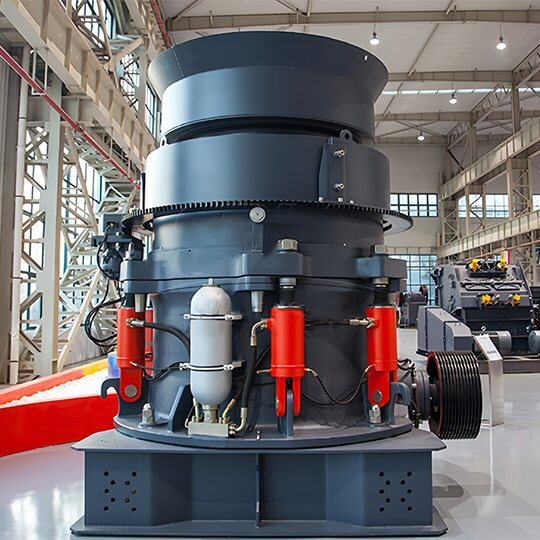
Cone Crusher Construction
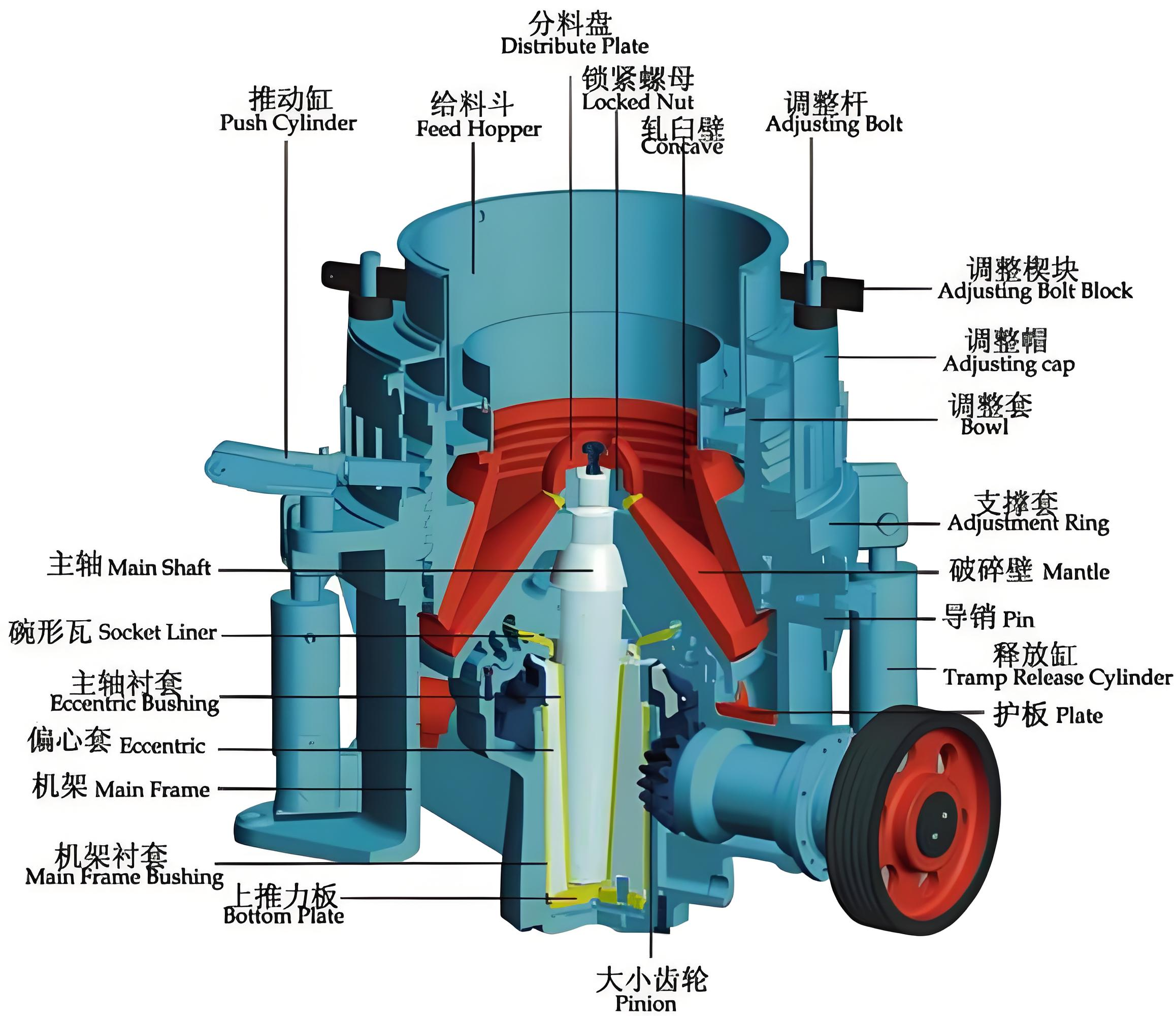
To better understand how it works, let’s look at the main components of a cone crusher:
- Mantle: A key wear part mounted on a rotating shaft. Its gyrating movement is what crushes the rock.
- Concave (Bowl Liner): The fixed outer lining that surrounds the mantle. The space between the mantle and concave forms the crushing chamber, where rock is actually crushed.
- Main Shaft: The central shaft that holds the mantle. It transfers power from the eccentric assembly to drive the mantle.
- Eccentric Assembly: The core mechanism that creates the gyrating motion. It makes the main shaft and mantle oscillate, compressing and crushing rock.
- Feed Hopper: The inlet where raw material is fed into the crusher.
- Hydraulic System: The most important system in modern cone crushers. It lets you adjust crusher settings while running, provides overload protection, and allows uncrushable materials (like tramp iron) to pass through without damaging the machine.
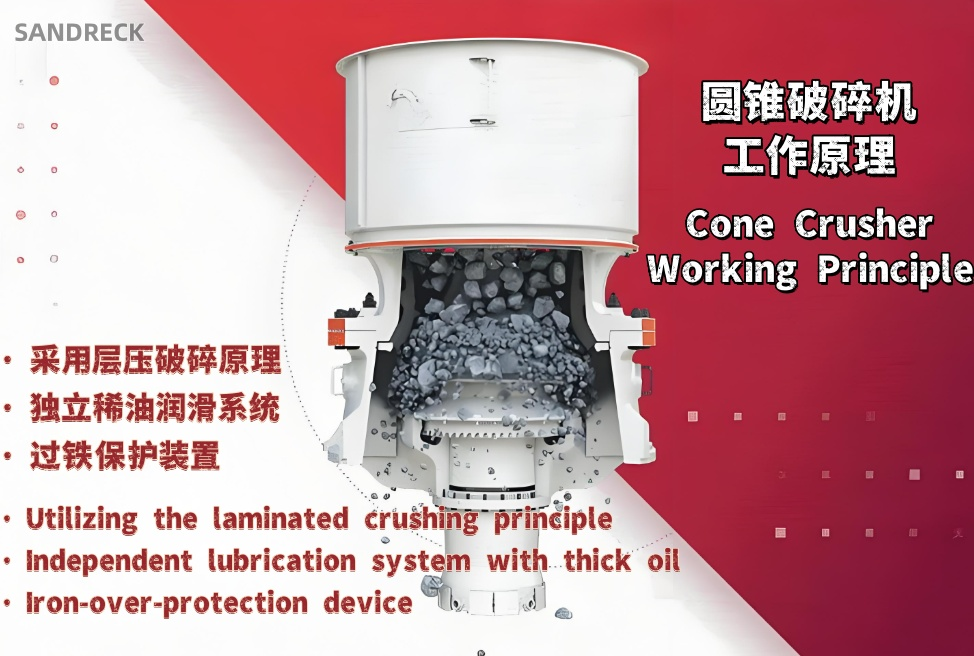
Cone Crusher Working Principle
At its core, a cone crusher operates on the simple yet highly effective principle of compression crushing.
Unlike impact crushers that use hammers to smash rock, a cone crusher squeezes the material between two surfaces: a moving mantle and a stationary concave liner.
This method applies immense, continuous pressure to the rock, causing it to fracture along its natural fault lines.
This results in a more cubical and uniform end product, which is highly desirable for construction and asphalt production.
The Crushing Process of Cone Stone Crusher
Feeding: The crushing process begins with large rocks fed by gravity from above into the crusher’s feed hopper. The material then moves down into the crushing chamber.
Compression & Breaking: The mantle gyrates inside the concave, moving alternately closer to and farther away from the concave wall.
As the mantle moves toward the concave, it strongly compresses the rock between them, causing it to break under pressure.
Progressive Crushing: The crushing chamber is specially designed with a wider gap at the top and a gradually narrower gap toward the discharge end. Rocks are crushed repeatedly as they travel downward.
Larger rocks are first broken into coarse pieces near the top, then reduced to finer sizes as they move down.
Discharge: Once the crushed material is small enough to pass through the narrowest gap at the bottom of the chamber — known as the Closed Side Setting (CSS) — it exits the cone crusher.
CSS is a critical adjustment that directly controls the final product size. A smaller CSS produces finer material.
For more help and valuable insights with industry-leading crushing solutions, consult the experts at Sandreck.