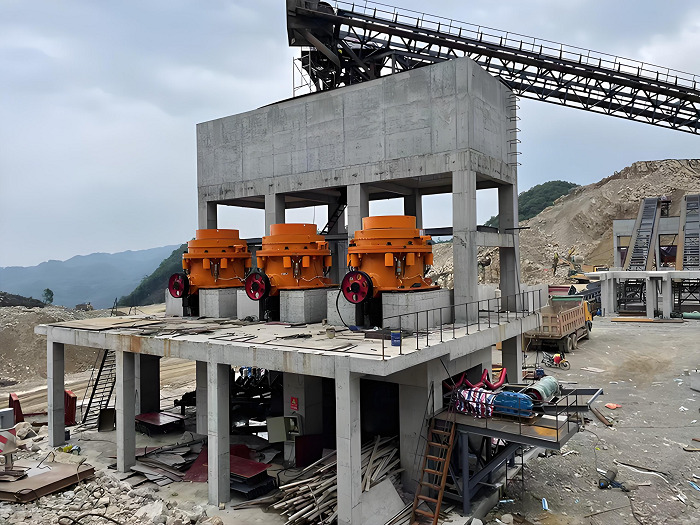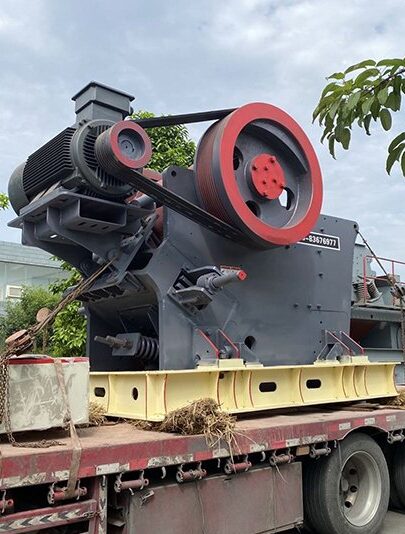

A cone crusher is one of the most important pieces of equipment in any aggregate, mining, or quarrying operation, and its reliable, long-term performance depends on the quality of its cone crusher parts. Sandreck offers cone crusher parts for sale, available as standard or tailor-made to your application requirements.

1. Wear Parts of Cone Crusher
These cone crusher parts touch the material directly, need replacing most often and are the largest item in any crusher maintenance budget.
1) The Bowl Liners/ Concave
The stationary liner installed inside the upper frame. Together with the mantle, it defines the crushing chamber profile and the closed side setting (CSS), which directly determines the final product size. Chamber profiles range from coarse to fine, so one crusher can handle primary, secondary or tertiary duty just by changing liner shape.

2) Mantle (Moving Liner)
The moving crushing member mounted on the main shaft head. This cone-shaped liner gyrates eccentrically inside the chamber, pressing rock against the concave to break it. Most mantles are cast from high-manganese steel (for example, Mn18Cr2), a grade that work-hardens under impact and gets harder as it crushes.

3) Feed Plate / Feed Cone
At the top of the chamber, the feed plate spreads the incoming material evenly so wear stays uniform. Uneven feed wears one side faster, shortening liner life and hurting product consistency.
4) Torch Ring
A protective ring that stops material packing between the bowl and the adjustment ring. Without it, trapped fines jam the adjustment mechanism.
Notes: The lower chamber usually wears fastest, since that is where final compression happens. Check liner thickness and replace before it drops below the minimum safe level.
2. Main Frame and Upper Assembly
1) Main Frame
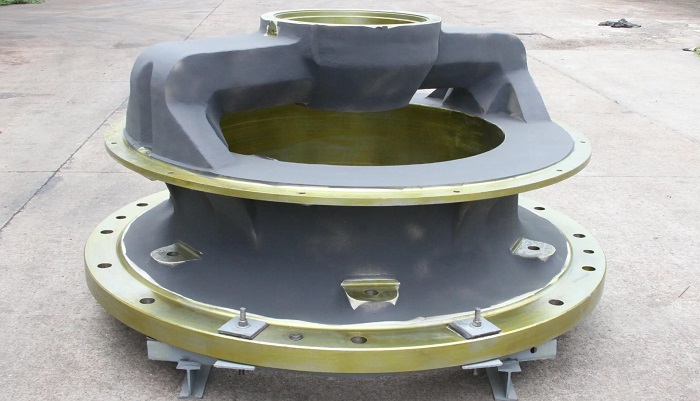
The heavy cast or welded lower structure that supports the whole crusher and absorbs the massive crushing forces generated in the chamber. It also houses the eccentric assembly, the gears and the lubrication oil sump. Large frames are cast in high-grade steel or ductile iron and machined on critical faces to keep the shaft, eccentric and gear train accurately aligned.
2) Upper Frame / Spider
The top section of the crusher that holds the bowl liner and carries the adjustment ring. On some designs, a spider bearing in the upper frame supports the top of the main shaft and keeps it stable. High-tensile bolts bolt the upper frame to the main frame, and dowel pins keep the two halves aligned.
3) Adjustment Ring
Supports the bowl liner assembly. Rotating it moves the concave up or down, raising or lowering the CSS and changing the product size. On modern hydraulic cone crushers, operators adjust this hydraulically from a control panel. On older spring cone machines, the ring is turned with a bar.
4) Locking Ring & Clamping Cylinders
The locking ring sits above the adjustment ring and holds it firmly once set.
3. Main Shaft and Head Assembly
1) Main Shaft
The high-strength alloy steel shaft that carries the crushing head and transmits the gyrating motion from the eccentric to the mantle.
2) Crushing Head (Head Center)
The part of the shaft assembly on which the mantle is mounted. Its surface is machined to match the mantle’s back.

3) Socket Liner
Supports the lower end of the main shaft and lets the head pivot smoothly during the gyrating stroke.
4) Thrust Bearing
Takes the vertical thrust load from the eccentric and shaft, preventing the eccentric from being pushed upward during crushing.
Wear and Spare Parts for Sale
Sandreck has extensive experience in stone crusher manufacturing and industrial services. We offer high-efficiency ore crushing solution design and advanced equipment production. Moreover, we also provide high-quality products and excellent service.