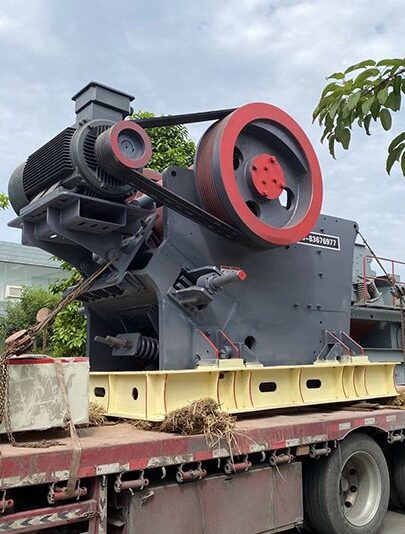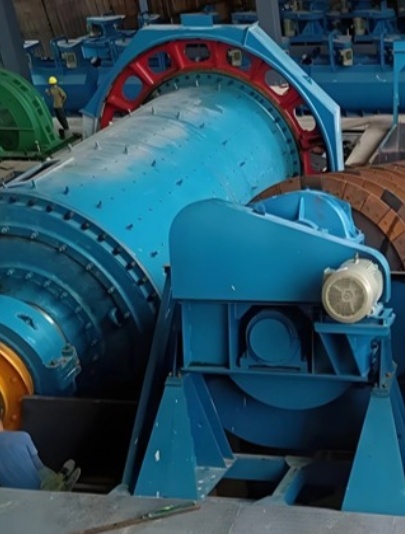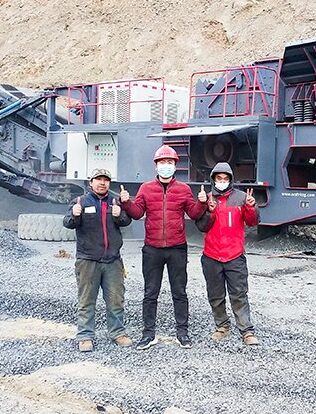

Hematite is widely distributed with substantial reserves and contains up to 70% iron. It serves as a core raw material for the steel industry and is a key mineral for investment and production in many mineral processing plants.
Have you encountered challenges like difficult separation, high costs, and equipment selection difficulties, leading to failed investments or poor production efficiency? This article will share five key aspects of hematite to improve production efficiency and investment returns.
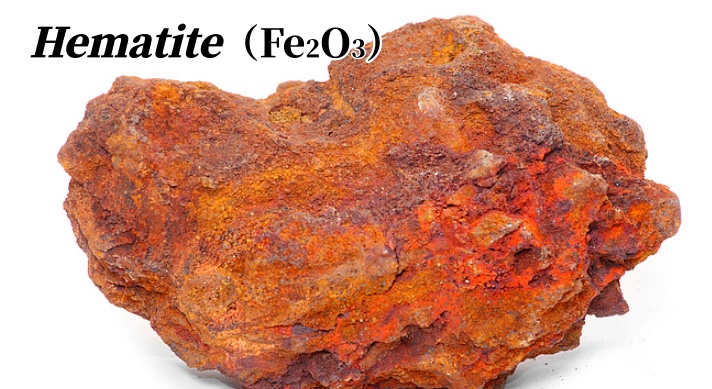
Ⅰ.What is Hematite
Understanding hematite’s composition enables rapid and accurate ore identification, facilitating the development of mineral processing plans that meet industrial utilization standards.
1.Chemical Composition
The core component of hematite is iron oxide (Fe₂O₃). It contains 70% iron and 30% oxygen. Naturally occurring hematite invariably contains impurities such as silica and alumina, which affect ore grade and beneficiation processes.
High-grade ore (grade ≥60%) exhibits strong workability and low processing costs; ore with grades between 20%–35% is classified as low-grade, requiring more complex beneficiation techniques.
2.Physical Properties
Color: Common hues include gray and dark red.
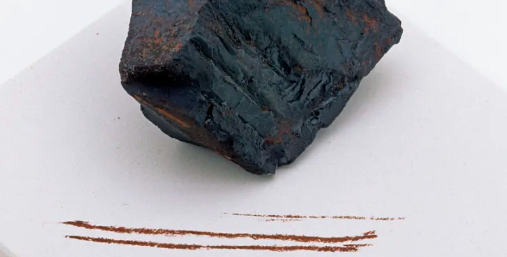
Streak: Scratching it on an unglazed porcelain plate leaves a cherry-red streak.
Crystal system: Hexagonal.
Hardness and density: Hematite has a hardness of 5.5–5.6; its density ranges from 4.9–5.3 g/cm³, giving it a heavy feel.
Magnetic properties: Hematite exhibits weak magnetism, with some specimens being non-magnetic.
Ⅱ.Formation and Deposits of Hematite
Understanding the formation and origin of hematite can help you analyze its quality, reserves and mining conditions.
1.Formation
The core condition for hematite formation is an oxidizing environment. Iron combines with oxygen to form iron oxide, which then crystallizes into hematite. Due to tectonic movements, volcanic eruption, weathering, and sedimentation, hematite deposits vary in type and grade across the Earth.
(1) Sedimentary Deposits: Hematite forms directly in shallow marine or lacustrine sedimentary environments. Oxidized iron is deposited and concentrated with sediment. Sedimentary hematite exhibits concentrated distribution, distinct bedding, and moderate grades. However, it often coexists with quartz, clay, and other impurities, presenting moderate separation difficulty.
(2) Hydrothermal Replacement: High-temperature hydrothermal fluids carrying iron ascend along fault zones from deep within the crust, reacting chemically with host rocks to form hematite. These deposits are typically high-grade, often exceeding 60% iron content.
(3) Weathering Deposition: Surface iron minerals (e.g., magnetite, limonite) undergo weathering and oxidation to form hematite. The iron minerals on the surface (e.g. magnetite, limonite) are weathered and oxidized to form hematite.
2.Deposits
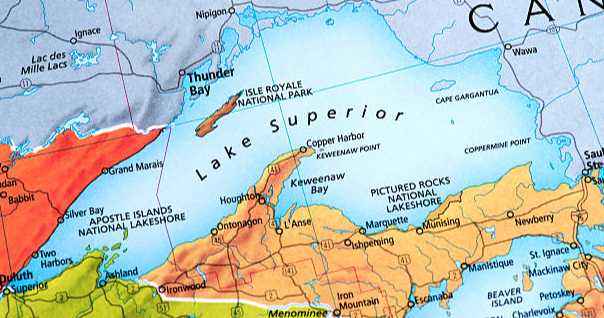
Hematite is widely distributed in the world. The Lake Superior region in North America and Canada is the largest hematite producing area in the world.
Australia: The world’s largest hematite exporter, primarily located in Western Australia. With grades reaching 60%–65%, these deposits are classified as high-grade ores. Favorable mining conditions (open-pit mining) and convenient transportation make Australia the primary source for many countries importing hematite.
Brazil: The world’s second-largest hematite exporter, primarily located in Minas Gerais state. Deposits feature grades of 55%–60%, abundant reserves, and advanced mining technology, resulting in export volumes second only to Australia.
Countries such as the UK, India, and South Africa also possess significant reserves of hematite.Indian hematite exhibits higher grades but faces relatively underdeveloped mining conditions. U.S. hematite deposits are primarily located in the Great Lakes region, near steel production areas, with convenient transportation.
III. Classification of Hematite
Although hematite shares the same composition, its morphology and structure vary. The particle size distribution and impurity content of hematite influence mineral processing techniques and equipment selection.The main types of hematite are as follows:
1.Renal Hematite: Renal hematite forms hemispherical or grape-like aggregates with smooth surfaces. This morphology results from bacterial-influenced precipitation of iron in aqueous solutions, commonly found in crystal cavities within oxidation zones or hydrothermal deposits. When mixed with other iron ores, nodular hematite exhibits magnetic properties.
2.Specularite: Specularite forms within hydrothermal veins or through volcanic gas processes. It represents an aggregate form of hematite, typically appearing rose-like or lamellar. Its coarse grains range in color from steel gray to iron black. Due to its limited production, its industrial value as an iron ore is restricted. Currently, the world’s most renowned hematite mirror deposits are found in Switzerland and Brazil.
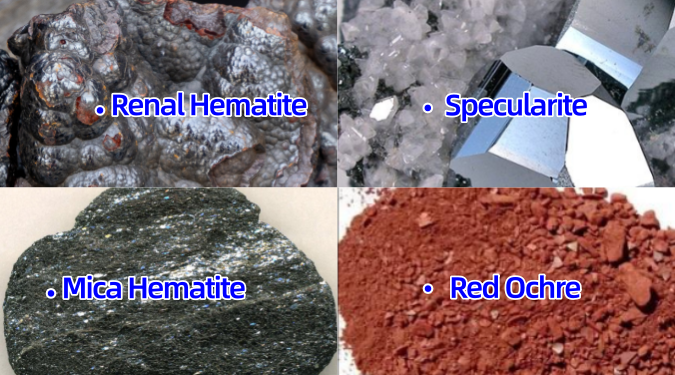
3.Mica Hematite: Mica hematite forms as fine, scaly aggregates. It has specialized industrial applications, such as serving as a functional filler in rust-preventive pigments. Brazil and Italy’s Elba Island are prominent sources of this ore.
4.Red Ochre: Red ochre appears as earthy or powdery aggregates with a vivid red color. As one of hematite’s most primitive forms, it grinds easily and became one of the earliest natural pigments used.
Ⅳ.Uses of Hematite
The hematite you possess is primarily used as raw material in the iron and steel industry. Simultaneously, hematite plays significant roles in pigments, chemical engineering, environmental protection, and other fields.
1.Iron and Steel Industry
Over 90% of hematite undergoes beneficiation processing for use in iron and steel smelting. Hematite grade, particle size distribution, gangue composition, and impurities all impact your production costs. Hematite used for smelting typically requires a grade of 65% or higher, with SiO₂ ≤ 8%, Al₂O₃ ≤ 4%, and harmful elements like sulfur and phosphorus no more than 0.05%. Failure to meet these standards compromises product quality.
2.Pigment Industry
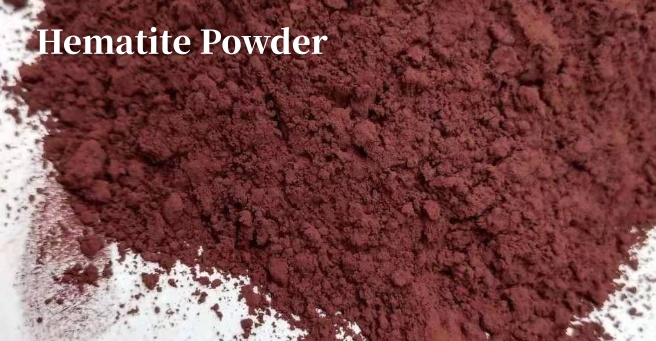
After grinding, grading, and purification, hematite can be processed into iron oxide red pigment. This pigment exhibits excellent lightfastness and alkali resistance, with stable chemical properties and low production costs. It is primarily used in construction, coatings, and artistic pigments.
3.Pharmaceuticals
Processed and calcined hematite forms the traditional medicinal ingredient known as “red ochre.” It promotes red blood cell production, improves blood circulation, and accelerates wound healing, serving as a tonic for the human blood and circulatory systems.
4.Jewelry
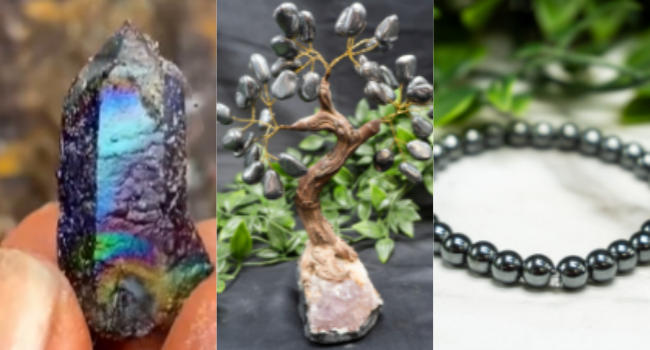
High-quality hematite, when cut, polished, and refined, serves as decorative or gemstone material. Some hematite is set in jewelry, while others hold collectible value. Countries like the United States, United Kingdom, Switzerland, and Italy are global producers of premium iron ore.
Ⅴ.Recommended Processing Equipment
Cone Crusher: Used for secondary crushing of ore after primary crushing, reducing your ore to 20–50mm. The cone crusher offers high crushing efficiency and uniform product particle size, which is suitable for medium-hard and harder hematite ores, especially lump hematite.
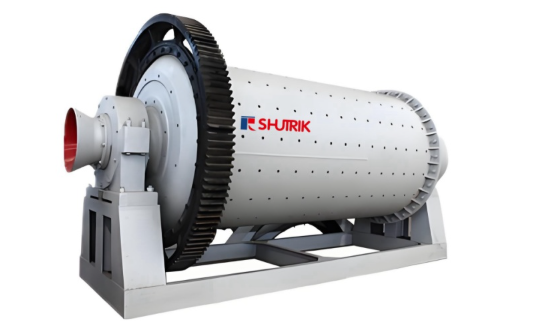
Ball Mill: This grinding equipment reduces crushed ore to particles smaller than 0.074mm. Its strengths include high throughput and the ability to grind various hematite types. A “single-stage grinding + secondary grinding” approach can be adopted to separate useful minerals from impurities.
Flotation Machine: Used for separating fine-grained, difficult-to-process hematite. It effectively separates valuable hematite particles from impurities. Its advantage is high sorting precision.It also can improve the grade of concentrate, but you should pay attention to the pollution of flotation reagents to the environment.
You should analyze the characteristics of different types of hematite based on your actual operating conditions and select appropriate equipment. This will enhance your iron ore recovery rate.
Conclusion
Hematite serves as both a core raw material for the iron and steel industry and possesses multiple applications. For mineral processing plants aiming to achieve high recovery rates and profitability, mastering the properties and key characteristics of hematite is crucial. We hope this article can assist you in processing hematite.
FAQs
Q: How can hematite and magnetite be quickly distinguished?
A: Two methods to help you distinguish: First, use a magnet—magnetite will be attracted, while hematite is essentially non-magnetic. Second, observe the scratch mark: Scratch the back of a white porcelain plate; hematite leaves a cherry-red trace, while magnetite leaves a black mark.
Q: Why is Australian hematite popular?
A: Australian hematite offers three major advantages: stable grade (mostly above 62%), low impurities (minimal phosphorus and sulfur content), and large-scale deposits. For mineral processing plants and steel mills, using Australian ore results in lower energy consumption, higher efficiency, superior product quality, and overall cost savings.
Q: How should high clay content in raw hematite ore be addressed?
A: Incorporate a washing stage after crushing and before grinding to remove most clay impurities. After grinding, use classification equipment to separate clay particles from hematite particles to avoid affecting subsequent mineral recovery rates.