
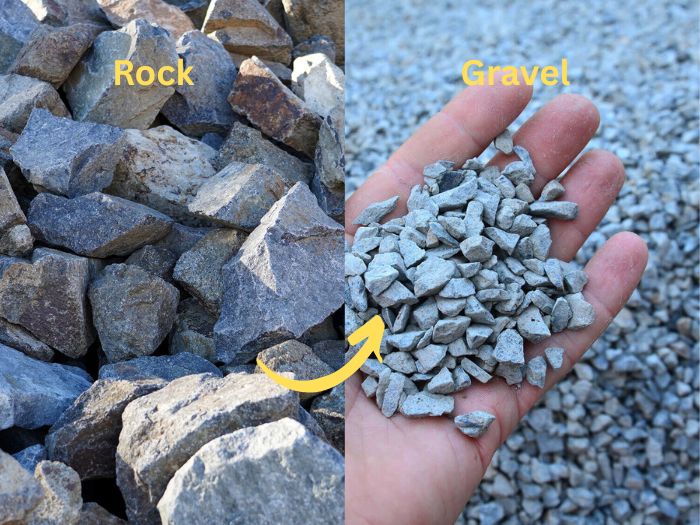
Gravel refers to small, loose fragments of rock, typically ranging in size from 2 to 64 millimeters. The most commonly used type of gravel in construction is crushed stone, which is produced by mechanically breaking up large rocks. Unlike smooth, naturally weathered river pebbles, crushed stone has rough, serrated edges that interlock when compacted, providing superior stability for roadbeds and foundations.
Producing high-quality gravel requires a systematic rock crushing process. This guide details the complete process of transforming raw rock into usable gravel, including key equipment and quality control steps.
Gravel Production Process
1. Raw Material Extraction
The first step in gravel production is finding suitable raw stones. Hard and durable rocks such as granite, limestone, and basalt are favored due to their high strength and resistance to weathering. Rocks can be mined from quarries or collected from open-pit mines. Pre-treatment is then performed to remove soil, clay, and organic debris that could contaminate the final product.
2. Primary Crushing
This stage is the initial step in crushing large rocks into more suitable sizes. It helps improve the efficiency of the entire crushing process and prepares the material for more precise particle size reduction.
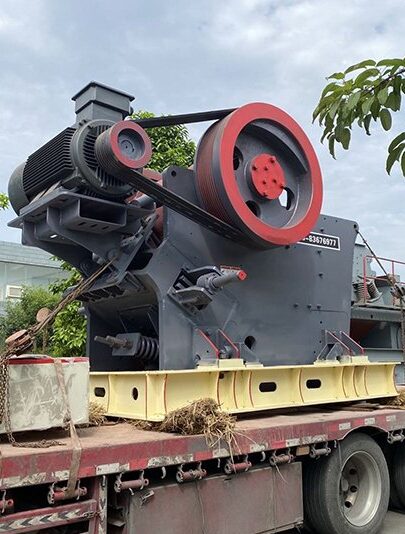
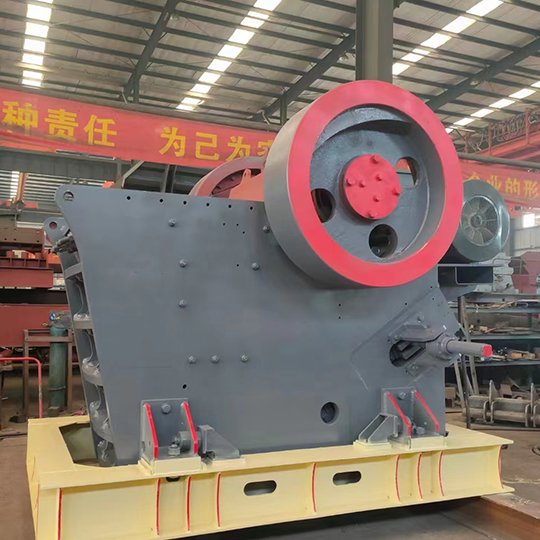
Jaw Crusher. The jaw crusher is one of the most commonly used primary crushers. Jaw crushers are ideal for crushing hard, abrasive rocks and for large-volume operations, making them a standard choice for quarries and mines.
After primary crushing, the finished material typically has a particle size of 100 mm to 300 mm.
3. Secondary Crushing
If the material from primary crushing is still too large to be used as gravel, it needs to be crushed to a gravel size (5-50 mm). Therefore, secondary crushing is necessary to achieve the desired particle size and further reduce the rock size.
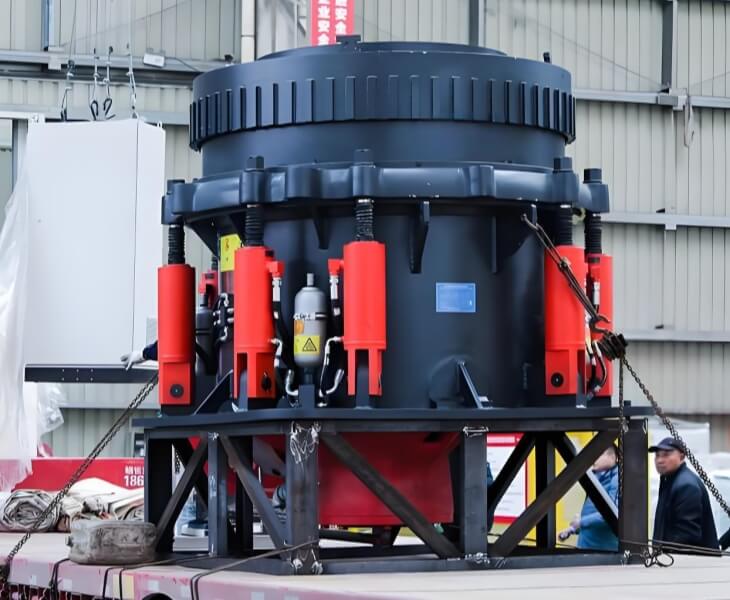
Cone Crusher. A cone crusher crushes rocks into smaller, more uniform particles by forcing them against a crushing bowl through rotation. They produce hard, well-graded, high-quality concrete aggregate ideal for the construction industry.
Impact Crusher. An impact crusher uses high-speed rotating hammers to impact the rock. It produces angular, cubic crushed stone, ideal for driveways and sidewalks. Impact crushers are particularly suitable for crushing rocks of medium hardness. Therefore, they are more popular in many construction applications.
Secondary crushing equipment serves a dual purpose: reducing the size of the raw stone and improving the quality of the finished aggregate.
4. Tertiary Crushing
If very fine gravel is required or there are strict requirements for particle size and shape, tertiary crushing may be necessary.
VSI Crusher. It breaks rock particles into uniform cubic shapes by accelerating them and causing them to collide at high speeds, minimizing flaky defects. This step is crucial for producing high-quality gravel for high-strength concrete, asphalt mixtures, or landscaping.
Double Roller Crusher. Two parallel rotating rollers compress the material, crushing it into uniform, fine particles. They excel at producing cubic gravel with minimal flaky defects and precise particle size control.
5. Screening
The crushed material is then screened using a vibrating screen. This screen uses multiple layers of screens with different apertures. Adjusting the screen apertures allows for the processing of materials of various particle sizes.
Most gravel is sorted by grade: fine (5–10 mm), medium (10–20 mm), and coarse (20–50 mm).
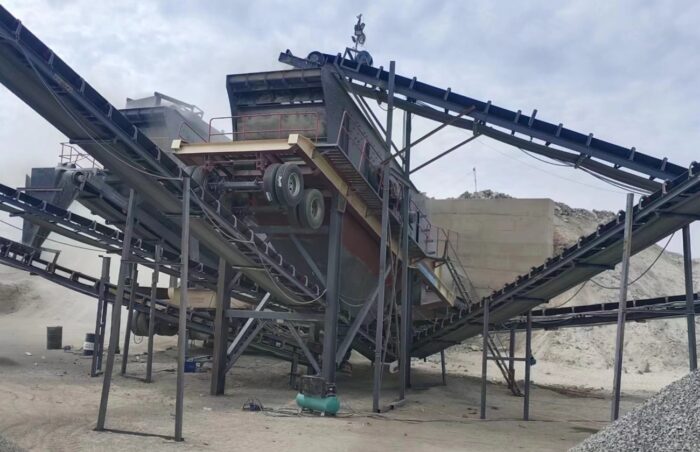
This is the complete process of crushing rock into gravel. If you encounter any problems with crushing stone, please leave your contact information, and our experts will develop a crushing solution for you.